
Regional collaboration aims to build leadership, workforce capacity and governance for the responsible use of artificial intelligence, genomics and precision medicine in strengthening Primary Healthcare and Universal Health Coverage.
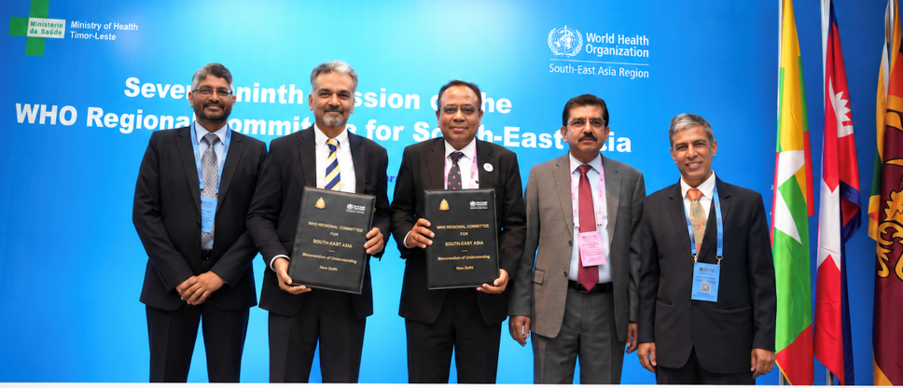
Prof. Vajira H. W. Dissanayake, Director Centre for Health Systems Policy and Innovation and the Chair and Senior Professor of Anatomy, Genetics and Biomedical Informatics, Faculty of Medicine, University of Colombo exchaning the agreement with Dr. Nilesh Buddha, Officer in Charge, WHO SEARO while Dr. Anil Jasinghe, Secretary, Ministry of Health, Mr. Manoj Jalani – Director Health Systems Development, WHO SEARO and Dr. Karthik Adapa, Regional Advisor for Digital Health and AI, WHO SEARO looks on at the 79th session of the WHO Regional Committee for South-East Asia in Dili, East Timor on 9 September 2026.
Recognising the rapidly growing importance of artificial intelligence (AI), genomics and precision medicine in transforming health systems, the World Health Organization (WHO) and the University of Colombo have entered into a Project Collaboration Agreement to strengthen regional leadership and capacity for AI-enabled precision medicine across the WHO South-East Asia Region.
As countries increasingly adopt digital technologies, AI and genomic medicine, the challenge is no longer simply one of acquiring new technologies. Health systems also need trained professionals, capable institutions, appropriate governance arrangements and practical models for translating innovation into better and more equitable healthcare.
The WHO–University of Colombo collaboration seeks to address these needs by supporting Member States to build workforce readiness, strengthen governance and policy frameworks, develop practical implementation knowledge relevant to low- and middle-income countries, and integrate AI-enabled precision medicine into primary healthcare in ways that contribute to Universal Health Coverage (UHC).
The University of Colombo brings more than two decades of experience in biomedical and health informatics, genomics and precision medicine. It has pioneered postgraduate education in Biomedical and Health Informatics and Clinical Genetics in Sri Lanka, contributed to national and regional digital health development, and undertaken work in AI governance, genomics, health systems innovation and capacity development through partnerships with WHO and other international organisations. The Centre for Health Systems Policy and Innovation in collaboration with the the Centre for Genetics and Genomics and the Centre for Digital Health and Health AI of the Faclty of Medicine under the leadership of Prof. Vajira H. W. Dissanayake, Chair and Senior Professor of Anatomy, Genetics and Biomedical Informatics would speadherad this collaboration.
Under the collaboration, WHO and the University will work across four major areas.
Building competencies and leadership will be a central priority; AI governance and health-system readiness; AI-enabled precision medicine within primary healthcare and UHC, and knowledge translation and policy support.
By strengthening these foundations, WHO and the University of Colombo hope to enable countries in the South-East Asia Region to move from experimentation with AI and precision medicine towards responsible, evidence-informed and sustainable implementation.
Ultimately, the initiative seeks to ensure that advances in AI, genomics and precision medicine do not remain confined to specialised centres or technologically advanced health systems. Instead, they should contribute to stronger primary healthcare, more personalised prevention and treatment, and equitable progress towards Universal Health Coverage throughout the region.
The Center for Health Systems Policy and Innovation was ceremoniously opened on 24 August 2023 by Dr Alaka Singh, WHO Representative to Sri Lanka with the participation of officials of the Asian Development Bank, Canadian High Commission, Ministry of Health, Ministry of Education, University of Colombo, other universities, development partners, academia and other professionals.
The Sri Lankan health system is recognized regionally and globally as a high-impact, low-cost model. This achievement was built on the foundations of a health care system that has been free at the point of delivery; adopting key primary health care principles since 1926. However, Sri Lanka’s health outcomes have been threatened by multiple challenges; the increasing elderly population, the rise of non-communicable diseases, the COVID-19 pandemic, and the most catastrophic economic and financial crisis of the country since its independence. These poly-crises have re-emphasized the importance of identifying evidence-based and high-impact interventions for strengthening the health system. A Policy Center focusing on national health priorities related to health systems and primary health care is critical to address the above needs.
At the request of the Ministry of Health, through a competitive process, World Health Organization (WHO) Sri Lanka selected academic partners to form the “Center for Health Systems Policy and Innovation” (CHSPI). The University of Colombo which is Sri Lanka’s oldest higher education institution founded in 1921 is functioning as the local academic partner of CHSPI while The George Institute for Global Health which is a leading independent global medical research institute with major Centers in Australia, China, India and the United Kingdom of Great Britain and Northern Ireland is the international collaborator. The CHSPI is hosted by the Faculty of Medicine, University of Colombo. This endeavor is supported by the Government of Canada and the Asian Development Bank.
The Center for Health Systems Policy and Innovation is expected to provide the necessary support needed for the Ministry of Health to generate high-quality evidence for informed decision-making, develop capacities of the health workforce, create a platform for knowledge sharing, build consensus around health sector reforms, and testing out new service delivery models and innovations related to primary health care. It is expected to provide a platform for all stakeholders including the Ministry of Health, other local universities, and international academic institutions to come together to provide practical and impactful support for health system strengthening in the country.
As its first capacity-building programme, CHSPI has now launched a virtual course on “Implementation Science: Adoption and Integration of Evidence-based Practices”, and 60 postgraduate trainees have been selected as the first cohort of participants. Further capacity-building programmes and policy dialogues are being planned to be conducted over the next few months.